TESS sectors 27–55 · TESSELLATE
Asteroid rotation & shape catalog
Rotation periods, phase-folded lightcurves and convex shape models for asteroids observed by TESS. Since TESS observes the same field continuously at high cadence for at least a month, these lightcurves can run unbroken for weeks — allowing us to recover precise rotation periods for both fast and slow rotators that are a challenge to recover from the ground.
12,068
with no previously published period
3,255
longer than 24 hours
46 days
median observing baseline
1,384
median measurements each
Search the catalog
Type a name or number for a quick look, or open one at random. Every object has a page: 14,768 carry a convex shape model, and 1,659 have a period and folded lightcurve but no model, each stating why.
| Object |
Period (hours) |
Amplitude |
Diameter (km) |
Type |
Symmetry |
LCDB (hours) |
Browse the full catalog → — all 16,427 objects, with filters and sorting.
The population
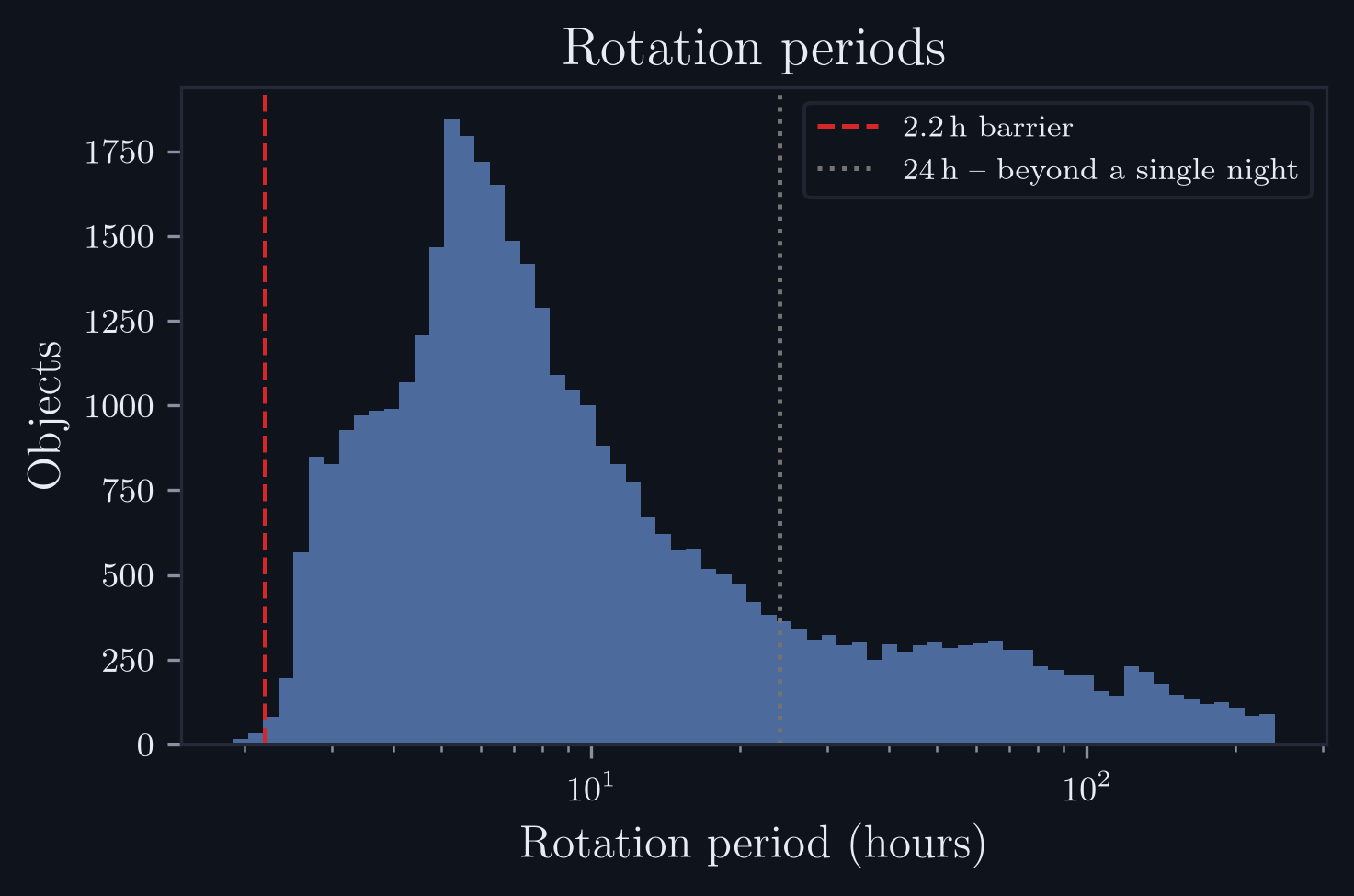 Rotation periods: 7,628 of 39,431 objects turn more slowly than once a day, the regime ground-based photometry struggles to close.
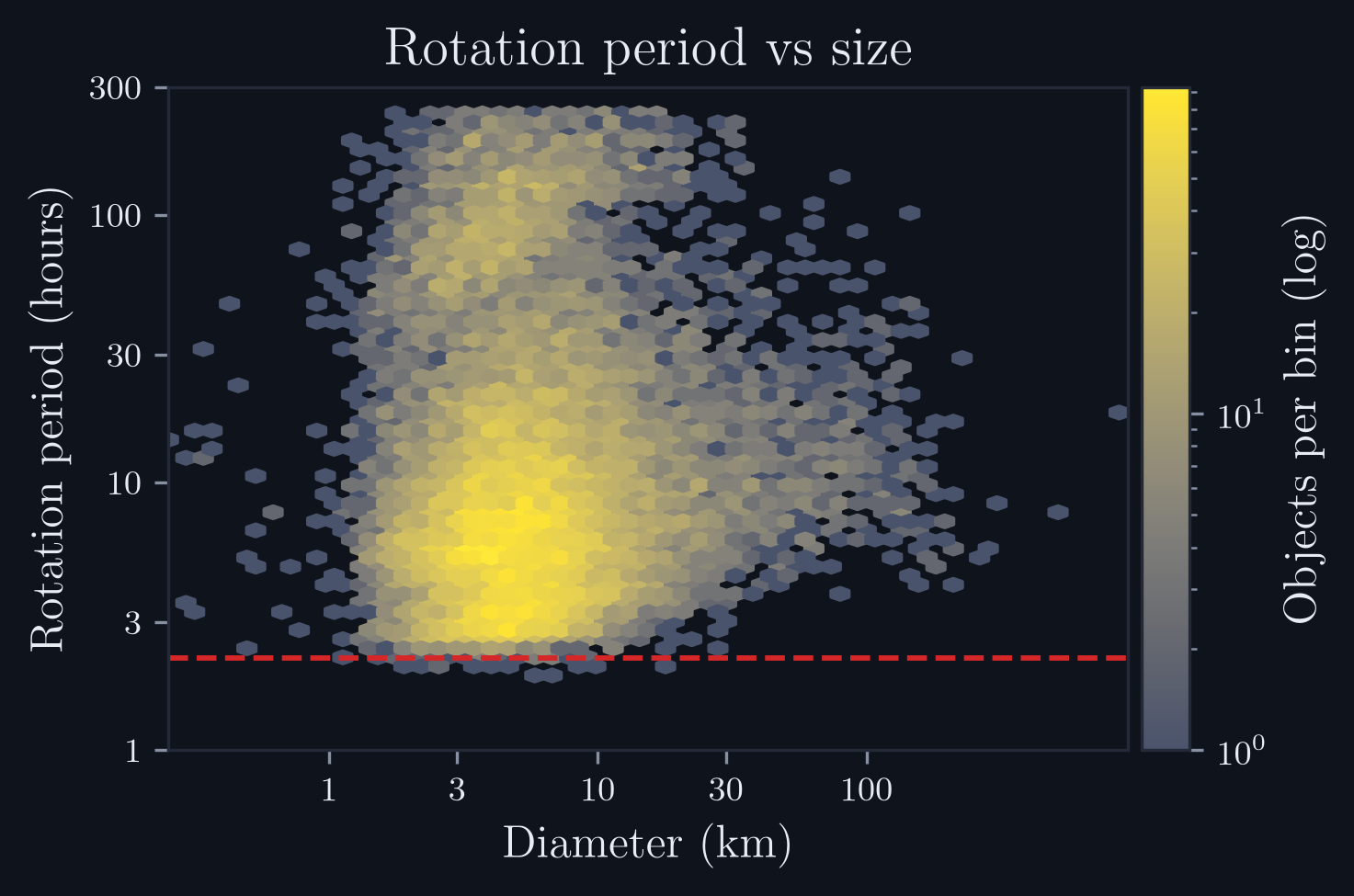 Spin rate vs size: only 19 objects with a known size sit above the 2.2 hour spin barrier, where a loosely bound rubble pile would fly apart.
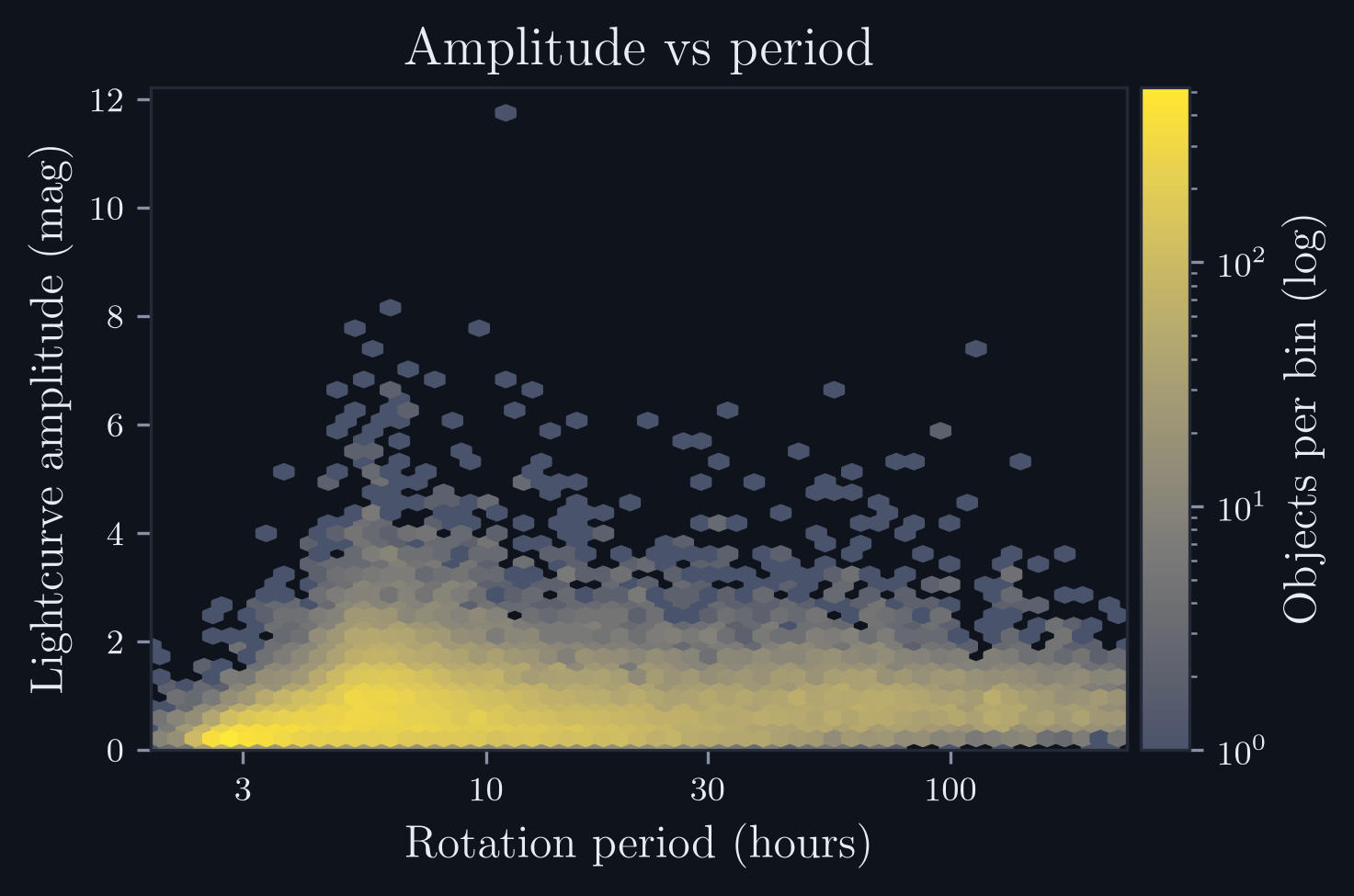 Amplitude vs period: Larger amplitudes imply more extreme aspect ratios.
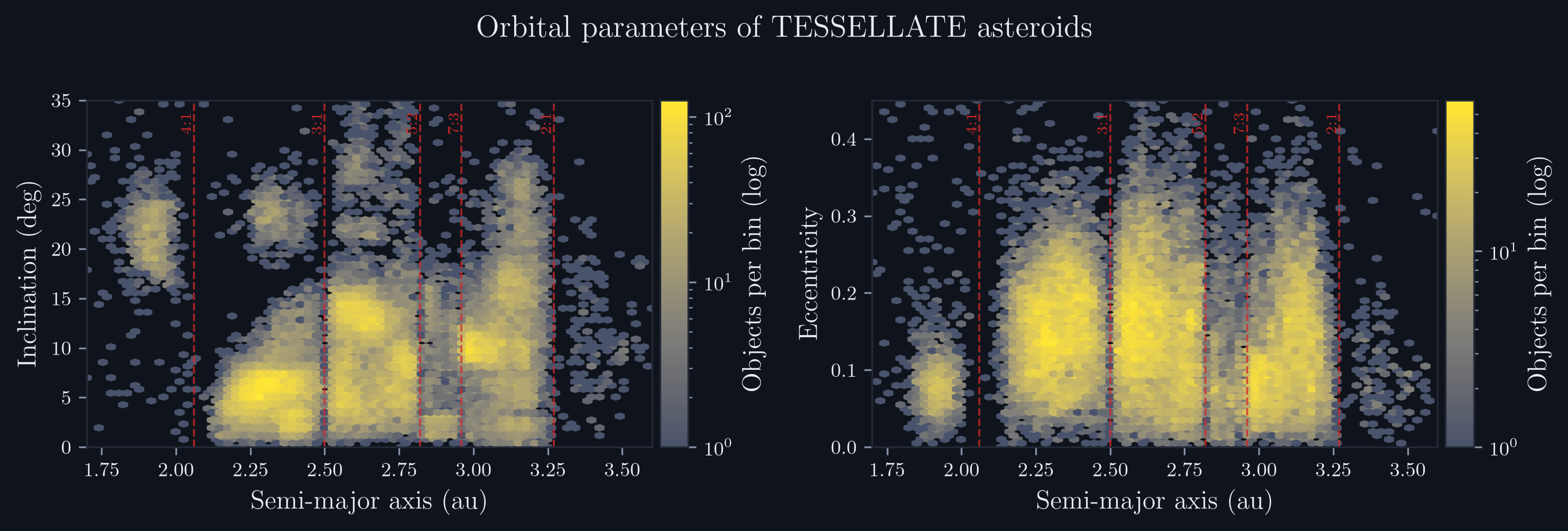 Orbital parameters: The dashed lines are Jupiter mean-motion resonances, which clear the Kirkwood gaps; clumps are collisional families. The catalog samples the inner, middle and outer belt about equally.
Available data products
Each object page carries its phase-folded lightcurve with per-bin uncertainties, the full stacked photometry behind it, and a rotatable convex shape model — all downloadable, and the shape model is synchronised to the lightcurve so you can watch which face produces which feature.
Data and photometry
Every lightcurve here is measured from TESS full-frame images by TESSELLATE, an untargeted time domain search across the TESS archive (Roxburgh et al. 2025). TESSELLATE builds on the difference-imaging reduction in TESSreduce (Ridden-Harper et al. 2021). Because TESS revisits the same field continuously, the resulting photometry is well suited to rotation periods: the sampling is near uniform and the coverage runs for weeks rather than hours.
Shape models
Shape models are produced by convex lightcurve inversion using convexinv, the implementation distributed with DAMIT. The method was developed by Kaasalainen & Torppa (2001) and Kaasalainen, Torppa & Muinonen (2001). The code and the Minkowski reconstruction that turns the fitted facet areas into a closed polyhedron are distributed through DAMIT, the Database of Asteroid Models from Inversion Techniques (Ďurech, Sidorin & Kaasalainen 2010). The rotation periods, the reliability classification and the shape fits presented here are produced by TESSELLATE; the inversion method and code are not.
Reading a shape model. Most of these asteroids were seen during a single apparition, from one direction. That constrains the shape but not its orientation in space, so the spin axis is assumed rather than measured, as indicated on each page. Convex inversion also cannot represent concavities, so models with sharp or complex minima fail to generate a shape model with convex. The rotation periods, by contrast, are well determined, and often more precise than the Light Curve Data Base (LCDB).